

AI Is Not a Monolith: Bold Lessons from Joshua Fecteau at the CAIO Connect Podcast with Sanjay Puri

CAIO Connect Podcast
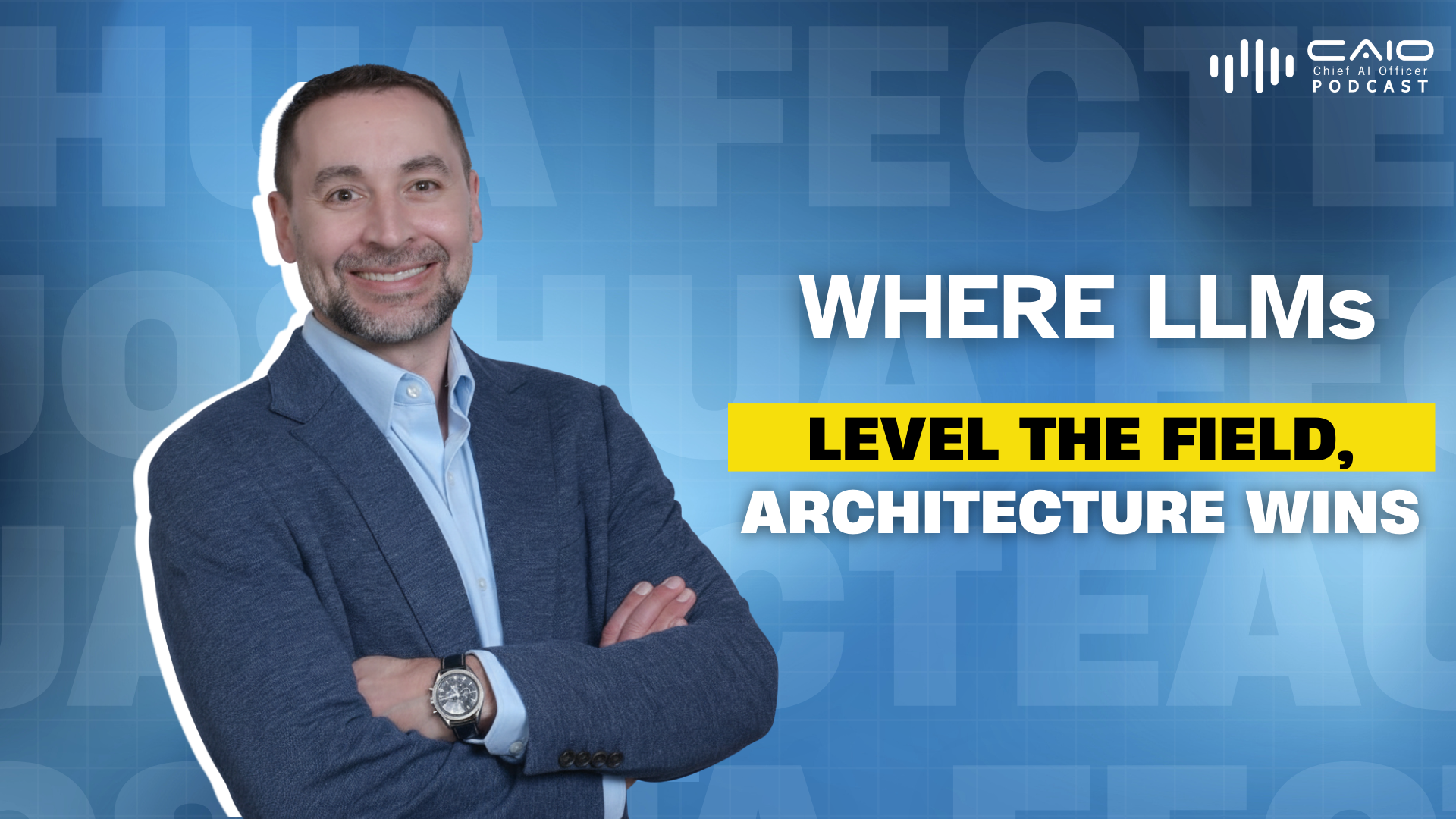
Joshua Fecteau, Chief Data & AI Officer, Teradata
AI isn’t a win by default—architecture, truth, and strategy determine who actually turns AI into real business impact.
If you’re not recalibrating our AI strategy every six months, it’s going to be obsolete.”
WASHINGTON, DC, UNITED STATES, March 3, 2026 /EINPresswire.com/ -- In the current enterprise landscape, "using AI" is often treated as a victory in itself. However, as the initial hype of 2024 and 2025 gives way to the scrutiny of 2026, a more sobering reality is emerging: AI is not a monolithic solution, and its casual deployment poses significant risks to institutional integrity and public trust.— Joshua Fecteau
During a recent episode of the CAIO Connect Podcast, host Sanjay Puri sat down with Joshua Fecteau, the Chief Data & AI Officer at Teradata, to challenge the "shiny object" syndrome currently infecting many boardrooms. Their conversation highlighted a critical shift: moving from data warehousing to autonomous intelligence is not merely a technical upgrade; it is a fundamental shift in how organizations generate and verify "truth."
The Erosion of Enterprise Truth
For journalists and media scholars, the most pressing concern is the source of information. When an organization—be it a tech firm or a newsroom—deploys an autonomous agent to make decisions or generate content, what is that agent anchoring to?
Fecteau argues that without a "data foundation" or a "semantic layer" that defines hard truths—such as financial records or master customer data—AI models are prone to intensified hallucinations. In a journalistic context, this is the difference between a verified report and a plausible-sounding fabrication. Puri and Fecteau establish that architecture is not just a technical choice; it is a governance safeguard.
The Accountability Problem in Autonomous Systems
The ERAI Fellowship’s focus on accountability is particularly relevant when discussing "agentic AI"—systems designed to act semi-autonomously. On the CAIO Connect Podcast, Fecteau posed a question that every media leader should consider: Who is responsible when an autonomous system fails?
If an AI agent executes a transaction or publishes content that is irreversible and harmful, accountability cannot be outsourced to the algorithm. Sanjay Puri emphasized that the "Human-in-the-Loop" model is no longer an optional safety feature; it is a professional responsibility. As these systems scale, the risk of "shadow AI"—applications running without oversight—threatens to create an environment where decisions are made without a clear trail of responsibility.
Strengthening Judgment Over Hype
The "honeymoon period" of AI experimentation is ending. As Fecteau noted, the "leash is tightening" as shareholders and the public demand early "proof points" and quantifiable returns. For the media professional, this requires a shift in judgment. Instead of reporting on what AI can do, the focus must move to what AI should do and how those systems are governed.
As we move toward a world where knowledge is generated at a pace humans cannot consume, the role of the CDAO—and the journalist—is to act as a bridge. The takeaway from the CAIO Connect Podcast is clear: we must ensure that the nexus between technology and decision-making remains anchored to verifiable facts.
Ultimately, the survivors of this transformative moment won't be the ones who adopted AI the fastest, but those who wielded it with the most rigorous architectural and ethical discipline.
Upasana Das
Knowledge Networks
email us here
Visit us on social media:
LinkedIn
Instagram
Facebook
YouTube
X
Legal Disclaimer:
EIN Presswire provides this news content "as is" without warranty of any kind. We do not accept any responsibility or liability for the accuracy, content, images, videos, licenses, completeness, legality, or reliability of the information contained in this article. If you have any complaints or copyright issues related to this article, kindly contact the author above.
