

Beinsure Forecast: InsurTech Market Enters Infrastructure Phase as AI Drives Selective Growth

InsurTech funding turned up in 2025 after several weak years. Investment across the sector rose 19.5% year over year to $5.1 bn, the first annual gain since 2021
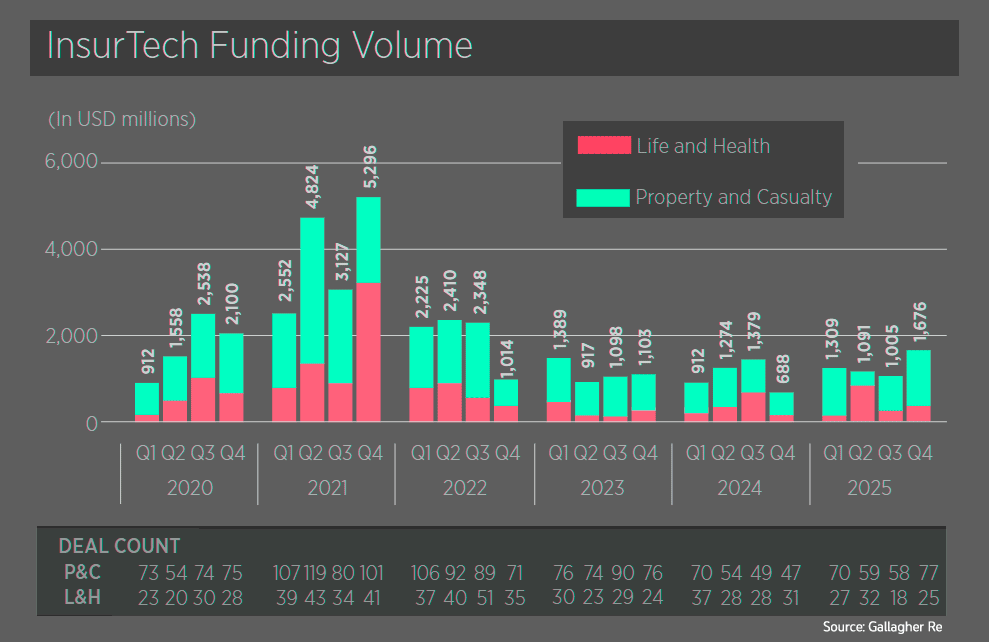
InsurTech funding volume (2020-2025)
Beinsure analysis shows InsurTech shifting from disruption to integration, with AI-led funding, investor demand for profitability shaping the market
Beinsure forecasts that the global InsurTech market has entered a new phase, where growth will be driven not by replacing insurers, but by embedding technology into the core of insurance operations.
According to report named “InsurTech Shifts from Disruption Hype to Durable Insurance Tech Models”, a decade ago, the story looked very different. Startups positioned themselves as challengers ready to rebuild insurance from scratch. Venture capital followed aggressively, with global InsurTech funding peaking above $15 bn in 2021. That phase has now closed.
FUNDING STABILISES, BUT BECOMES MORE SELECTIVE
Global InsurTech funding reached $5.1 bn in 2025, marking a 19.5% year-on-year increase and signalling a partial recovery after a weaker 2024. The rebound was driven by a strong fourth quarter, which alone accounted for $1.68 bn. But the composition of funding matters more than the headline number.
P&C drove most of the late-year move. Funding in the segment climbed 90.5% quarter over quarter to $1.31 bn. L&H also moved higher, though at a slower pace, rising 14.9% to $361.52 mn.
“Investment has become more concentrated, more selective, and more aligned with insurance fundamentals. Nearly 75% of 2025 funding went to AI-focused companies, particularly those targeting underwriting, claims, and risk assessment”, noted Oleg Parashchak, CEO and founder of Finance Media and Beinsure.
The quarter also brought a wider funding base. More than 100 InsurTechs raised capital, the first time the market reached that level since Q1 2024, according to Gallagher. Deal count increased 34.2% quarter over quarter to 102, and average deal size rose 20.0% to $18.84 mn in Q4 2025.
The broader annual picture points the same way. Global InsurTech funding increased from $4.25 bn in 2024 to $5.08 bn in 2025. P&C InsurTech, which hit a low point in 2024, rebounded 34.9% year over year to $3.49 bn in 2025.
One more detail stands out. AI-centered companies captured 77.9% of all InsurTech funding in Q4 2025, a sign of where investors placed their bets as the year closed.
At the same time, re/insurers became more active investors, completing a record 51 technology investments in Q3. That shift reflects a deeper strategic alignment, insurers are no longer watching from the sidelines, they are shaping the ecosystem.
However, the trend is positive and suggests a rebound in funding in the fourth quarter, marking the ecosystem’s stability at 2018 levels.
• The stabilization in insurtech funding is being led by breakout-stage insurtech startups (Series B and C), which are showing notable recovery and approaching pre-pandemic funding levels.
• Early-stage startups (pre-seed, seed, and Series A) are also contributing to this stabilization.
• Late-stage startups continue to face challenges, with funding levels lagging behind, reflecting the broader market’s cautious stance on mature, high-valuation companies.
Beinsure analysis shows a clear move away from early-stage risk. Up to 60% of investments now target more mature, late-stage companies capable of delivering immediate returns.
“Debt financing has also grown rapidly, with a 97% CAGR since 2021. Startups are increasingly using alternative capital structures to manage costs and extend runway in a more disciplined funding environment”, Oleg Parashchak says. “This is not a funding boom. It is a recalibration”.
FROM DISRUPTION TO INTEGRATION
The early InsurTech wave was built on a simple idea, replace incumbents. Digital-first carriers, embedded distribution models, automated claims platforms, the ambition was broad and capital followed scale. But insurance never behaved like a typical tech sector.
Capital intensity, regulatory oversight, and strict risk discipline limit how fast change can happen. Those constraints eventually pushed back.
Beinsure forecasts that the dominant model going forward is integration, not disruption.
“Companies are no longer trying to rebuild insurance. They are building infrastructure that insurers can plug into existing systems, improving efficiency, reducing costs, and enhancing underwriting precision”, Pararshchak noted. The narrative has shifted from “replace” to “enable.”
Early InsurTech prioritised growth, often at the expense of unit economics. Consumer-facing carriers led the expansion. The result was innovation, but also exposure to the structural limits of insurance as a regulated, capital-heavy industry (see insurtech news about startups funding - https://beinsure.com/n/insurtech-news/).
Now the question has changed. Where can technology deliver repeatable, measurable gains?
Beinsure identifies infrastructure as the defining theme of the next InsurTech cycle.
“The companies gaining traction are those solving specific, high-friction problems within insurance workflows. These include underwriting gaps, claims inefficiencies, and distribution bottlenecks”, Oleg Parashchak stated.
Rather than competing with insurers, they integrate into existing processes through APIs, modular systems, and data layers.
This shift is reflected in investment patterns. In 2025, funding favoured startups focused on core insurance operations, underwriting, claims, and risk analytics, rather than front-end distribution plays or untested business models.
AI plays a central role here, but not as a standalone solution. Its value emerges when embedded into operational workflows.
According to Beinsure analysts, AI adoption in insurance remains constrained by legacy systems, fragmented data, and integration challenges (see What Drives the Accelerated AI Adoption in the Insurance Industry? - https://beinsure.com/ai-adoption-in-insurance/ ). These barriers limit large-scale deployment despite rapid technological progress. The implication is clear. Technology alone is not enough. It must fit the system.
THE FAILURE RATE TELLS THE STORY
InsurTech remains a high-risk sector. Around 90% of startups fail, highlighting the difficulty of building scalable models in insurance.
“The first wave leaned heavily on ambition, faster claims, digital carriers, new distribution models. The concepts were compelling, but execution proved harder”, Oleg Parashchak says. “Today’s successful companies operate differently. They focus on measurable impact, faster processes, lower costs, improved loss ratios”.
Over the past 20Y, the sector has moved from disruption narratives to a more pragmatic, value-driven approach. The complexity of underwriting, regulatory frameworks, and long-term risk exposure has reshaped expectations.
Investors now demand proof.
Beinsure analysis identifies three key filters that will separate successful InsurTech companies from the rest.
• First, alignment with insurance fundamentals. Solutions must reflect regulatory requirements, capital constraints, and risk dynamics. Technology that ignores these realities will not scale.
• Second, integration capability. Winning platforms embed seamlessly into existing systems. APIs, modular architecture, and interoperability are now baseline requirements.
• Third, measurable outcomes. Investors and insurers expect hard metrics, improved efficiency, reduced costs, better underwriting performance, and clear return on investment.
• These filters define the new standard.
AI DOMINATES, BUT DOES NOT DEFINE THE MARKET
Artificial intelligence remains the central theme in InsurTech investment. It drives funding, shapes product development, and attracts strategic interest from insurers. But Beinsure forecasts that AI will not define the market on its own.
Its role is increasingly embedded rather than standalone. AI enhances underwriting accuracy, accelerates claims processing, and supports fraud detection. Yet its impact depends on data quality, system integration, and operational alignment. In other words, AI is a tool. Infrastructure is the foundation.
BEINSURE OUTLOOK: DISCIPLINED GROWTH, NOT HYPE
The InsurTech market is no longer driven by hype cycles. It is moving toward disciplined, incremental growth anchored in real business value.
According to Oleg Parashchak, funding has stabilised, but remains selective. Investors favour sustainability over scale, profitability over expansion, and integration over disruption. “Re/insurers are becoming active participants, shaping innovation through direct investment and partnerships. This trend is expected to continue, further aligning technology development with industry needs”.
Beinsure forecasts that the next phase of InsurTech growth will be defined by:
• Continued dominance of AI in underwriting and claims
• Expansion of infrastructure-focused solutions
• Increased collaboration between insurers and technology providers
• Greater emphasis on profitability and capital efficiency
• Ongoing consolidation as weaker players exit the market
The early vision promised transformation. The current phase delivers optimisation. And in a sector like insurance, that may be the more valuable outcome.
Full report - https://beinsure.com/insurtech-shifts-to-durable-insurance-tech-models/
Peter Sonner
Beinsure.com
email us here
Legal Disclaimer:
EIN Presswire provides this news content "as is" without warranty of any kind. We do not accept any responsibility or liability for the accuracy, content, images, videos, licenses, completeness, legality, or reliability of the information contained in this article. If you have any complaints or copyright issues related to this article, kindly contact the author above.
