

Unryo Uses Agentic AI to Correlate RAN Faults with Kubernetes Infrastructure
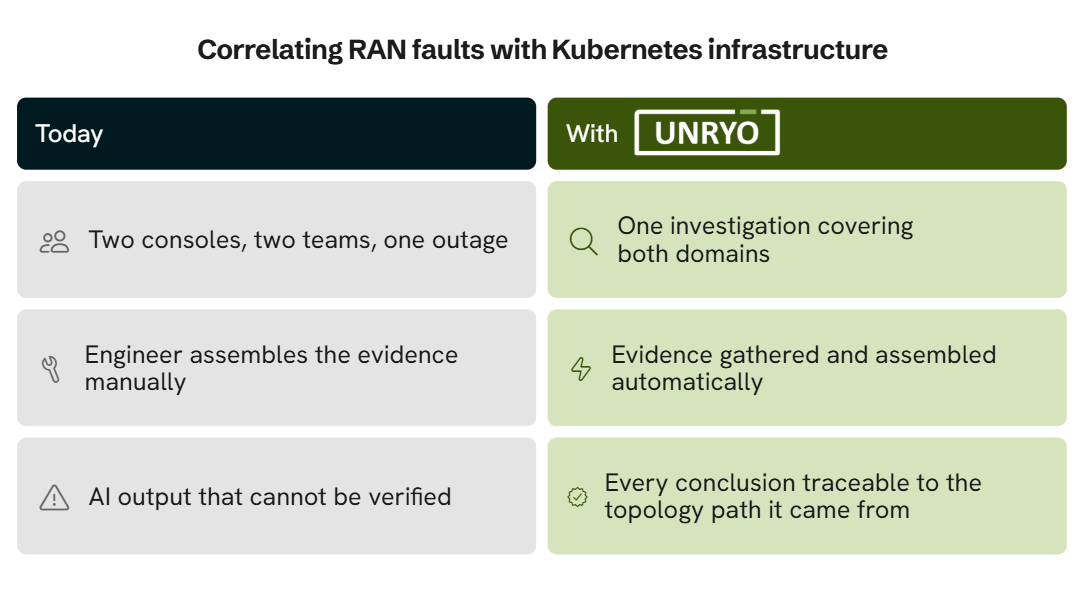
From two consoles and manual evidence-gathering to one cross-domain investigation: Unryo correlates RAN faults with the Kubernetes infrastructure beneath them, with every conclusion traceable to the topology path it came from.
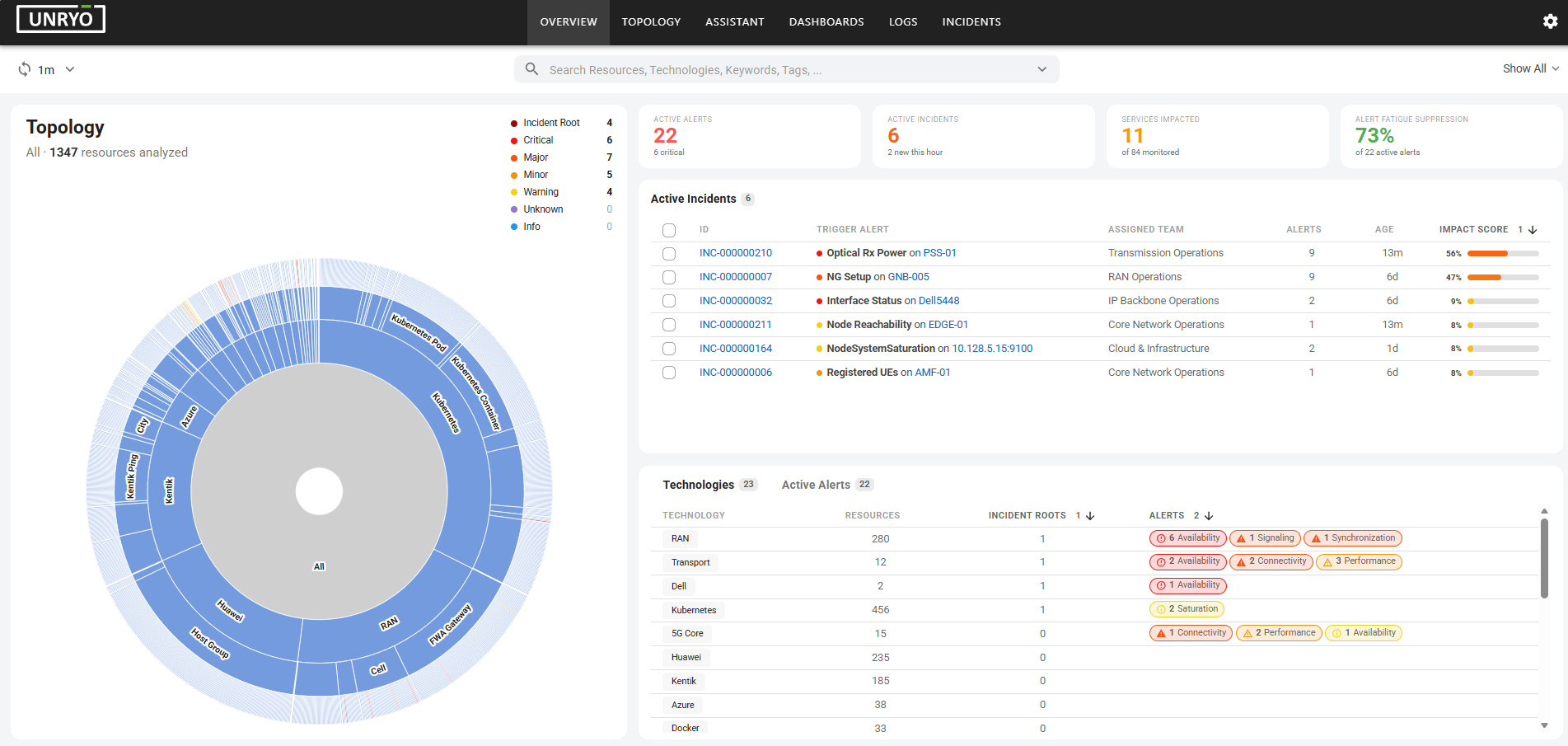
The Unryo platform overview shows radio access network and Kubernetes resources side by side, grouped by technology and type, with each active incident listed against the team that owns it.
Unryo has released agentic cross-domain investigation between RAN faults and the Kubernetes infrastructure running the network functions beneath them.
MONTREAL, QC, CANADA, September 25, 2026 /EINPresswire.com/ -- In a cloud-native Radio Access Network (RAN), the network functions serving a cell run as pods on a container platform. When a cell degrades, the cause can sit in either domain, and the two are usually instrumented by separate tools. The reconciliation happens on a bridge call, between two teams, during the outage.
Unryo automates that investigation. An agentic AI layer performs the steps an engineer would. It reads the alarm, walks the dependency path from the affected radio objects to the network functions serving them and the pods and nodes running those functions, and retrieves their state at the moment of the fault. It then checks radio counters and service-based interface signaling records from probes against platform events, and produces a written explanation of what failed and why.
For example, if a cell's throughput drops while its radio load and signal quality are unchanged, the agent can trace the cause to the Kubernetes node beneath it, which began dropping packets a minute earlier, and treat the pod restart that followed as a consequence. Both teams start from the same explanation, with the evidence from each domain already assembled, rather than reconciling two tools on a bridge call.
The reasoning is grounded rather than generative. Every step runs against Unryo's Topology Data Fabric, a live model built from the operator's own sources: vendor EMS platforms such as Nokia MantaRay and Ericsson ENM, the Kubernetes API, and SNMP or gNMI collection from transport devices. The model is updated as the network changes, and the underlying correlation is deterministic, so conclusions are reproducible and can be defended after the incident. The agentic AI layer is model-agnostic and available now, deployable on-premises or in an operator's private cloud, so telemetry and incident data stay inside the operator's environment.
About Unryo
Unryo is a full-stack observability and agentic AI platform for network operators. Its Topology Data Fabric discovers and maps multi-layer dependencies across physical, logical, and application infrastructure, giving AI agents the context to find root cause and drive resolution.
Available now, deployable on-premises or in an operator's private cloud.
www.unryo.com
Virginie Porter
Unryo Inc.
info@unryo.com
Visit us on social media:
LinkedIn
Legal Disclaimer:
EIN Presswire provides this news content "as is" without warranty of any kind. We do not accept any responsibility or liability for the accuracy, content, images, videos, licenses, completeness, legality, or reliability of the information contained in this article. If you have any complaints or copyright issues related to this article, kindly contact the author above.
